Addendum to The Return of the Rumba. “Franco, the Sorcerer of the Guitar.”
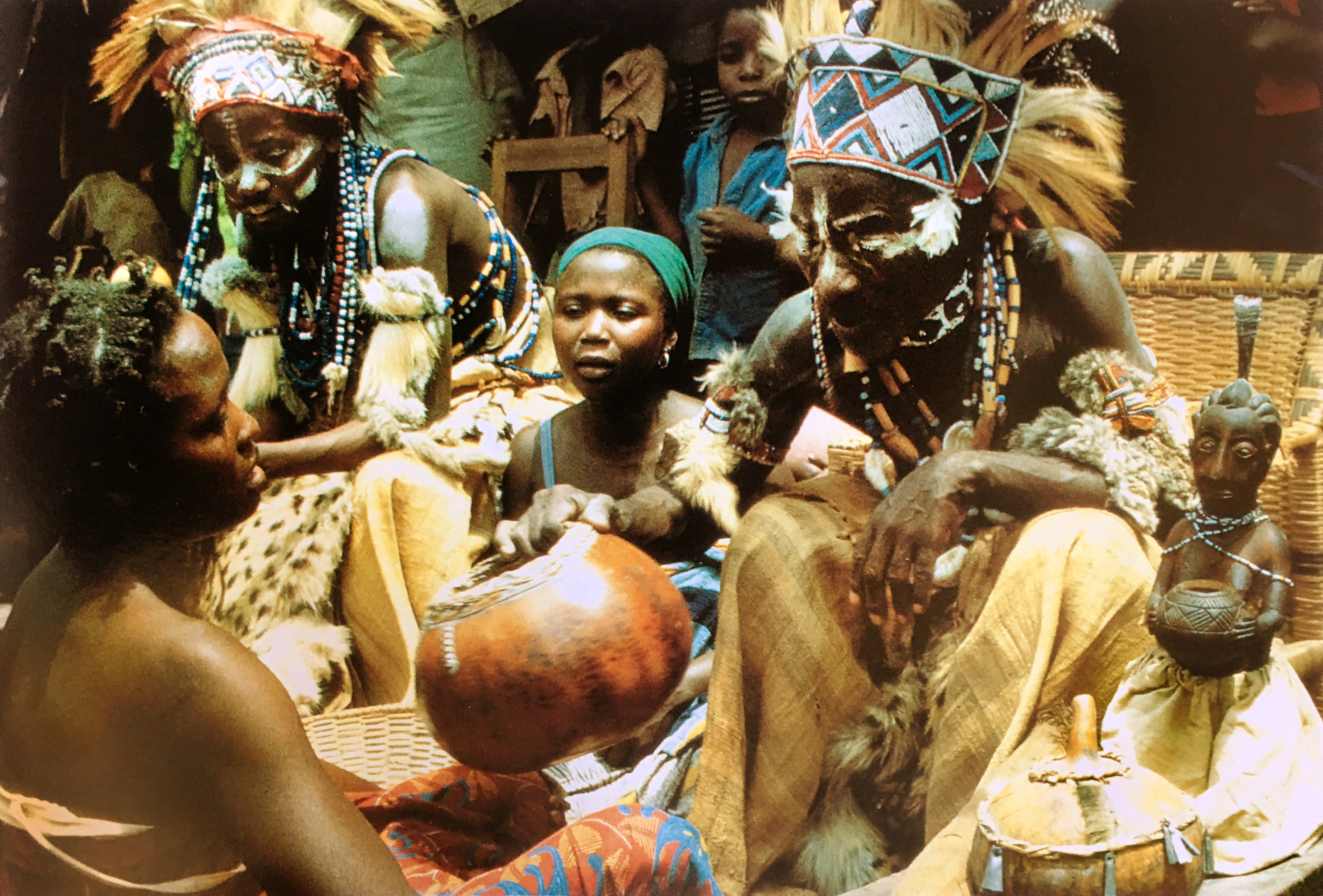
This image shot in 1989 by the late, respected Africanist professor and curator, Mary Nooter Roberts, depicts Luba Bilumbu diviners performing a series of Morning consultations in Zaire. From “Insight and Artistry in African Divination”, edited by John Pemberton III (Washington, D.C. ; London : Smithsonian Institution Press, 2000).
The role that mysticism, sorcery and divination play in the life of Congolese music and especially in the life and career of Franco—one of its prime progenitors—is what I want to prognosticate in this addendum. Rumours abound of his possible initiation into the occult. There can be no doubt that he received many blessings from Ngangas (priests and spiritual healers) across the continent. In Africa, ancestral worship via music as a medium has existed since time immemorial. Many of the Zairean musicians would visit Marabous/Ngangas as far afield as Senegambia and Benin to enact supernatural exchanges of empowerment—somewhat akin to the virtuosic guitar skills Delta Bluesman Robert Johnson displayed after he exchanged his soul with the devil (Oshun) at a Mississippi crossroads back in the early 20th century.
The prophetic Griot-like positioning of Franco as soothsayer and oral messenger of the multiple grass roots, ultimately welded his oft-controversial hegemonic bond with President Mobutu Sese Seko—Zaire’s despot dictator, who, after independence, oversaw the death of its first Prime Minister, Patrice Lumumba. Franco, under certain duress, was President Mobutu’s ultimate Authenticité propaganda machine. His spiraling, mesmeric guitar motifs tapped into ancient Sanza and Balophone frequencies, which, coupled with his Griotesque voice created an uncanny firebrand power of seduction and persuasion. Franco was an early exponent of Afrofuturism, with his close-knit community of musicians channeling and creating a unique fusionistic, panoptic blend of new Black African music within the confines of an ever-expanding collective. The band’s costumes and choreography perfectly fit in with the performativity associated with Afrofuturism, as did the lyrics, which often invited the participants to literally lose and surrender themselves in the kaleidoscopic realms of rhythm and dance. Liberation through dance was nothing new to Zaireans. The Kuba, Pende, Yaka and Suku—to name just four cultures of the region whose music has been documented since the advent of the phonogram machine—did exactly this with very large ensembles whose instrumentation included Balophones, various drummers, percussionists, singers and trumpets.
Even with the rupture of the cruel Belgian colonial project music accompanied every aspect of life: from giving birth, to hunting, to giving thanks for a plentiful harvest, to death. Franco’s chant-like choruses propelled his audiences into out-of-body nether regions without ever literally speaking on the topic of utopic outer-galactic theories propounded by the likes of Sun Ra. I very much doubt that Franco had even been exposed to Sun Ra’s music, and if he had, I’m not sure whether or not he would have appreciated it. As he often stated, he made music for people to dance to; he was all about the Sebene, the groove—he was a Shebeen dweller—but his was a uniquely Zairean Odemba groove, not to be confused with Afrobeat, Funk or Soul. On the occasion of the 1974 “Rumble in the Jungle” fight in Kinshasa between Muhammad Ali and George Foreman, Mobutu invited James Brown to play a concert at Zaire 74—the accompanying music festival organized by the late South African trumpeter Hugh Masekela. The concert took place in the Kinshasa football stadium. Franco and the T. P. O. K also performed. Franco attended the J.B. concert, but was apparently unimpressed with “The Godfather Of Soul’s” funk music and his accompanying deft footwork displays of the Mashed Potato and Camel Walk dances. Franco let it be known that he felt snubbed and somewhat insulted that J.B. had not shown any apparent interest in the local Zairean music scene or its personalities. But in actual fact, J.B. and Franco shared much in common in regard to being Sonic Healers, and both wore the crown of The Hardest Working Men in Show Business. During Mobutu’s dictatorship it was forbidden to listen to western music, though those with access to long-range radios obviously did. Furthermore, music from the African Diaspora was not categorized as western; hence, the line-up at the Zaire 74 music festival, which Mobutu expressed was intended to present and promote racial and cultural solidarity between African-American and African people. After more than thirty years of tyrannical rule and homeland pillage of Zaire’s natural resources, President Mobuto Sese Seko was overthrown by Laurent Kabila in 1997 and died in exile in Morocco of prostrate cancer, leaving behind a bankrupt country and a personal wealth estimated at somewhere between $1-5 Billion.
Bringing us back up to now, Transcultural music exchange in the Transnational African Diaspora and the continent of Africa is more plentiful in this our 21st century. The rapid access of information and knowledge sharing via technology has enabled digital collaborative practices to flourish. Within Afro-sonic navigational terms, we may permit ourselves to encounter imagined utopic planetary terrains, therein enabling the reinvention of past, present and future time-looped frequencies. I am arguing that Sonic Clairvoyance is in fact a musical form of ESP that can be used as an aid to visionistically dive into Black fantastical realms of hitherto unknowns.
Happy New Year to all of our dedicated Afro-Sonic Mappers – may 2019 bring you all that you desire and deserve.
In this century, any in-depth research on African music will require the researcher to travel to various locations in the Transnational African Diaspora. In this particular researcher’s humble opinion, the most fruitful locations are the Americas and the Caribbean Basin. A good example is the preservation of certain Congolese rhythm patterns by the Palenque in Cartagena de Indias, Colombia. The Palenque, who were Maroons (runaway slaves) – the word Maroon comes from the Spanish word Cimarrón, based on a Taino Indian root – were, in fact, the first free Africans in the Americas. The Spanish crown issued a royal decree in 1691, guaranteeing freedom to the Palenque de San Basilio. The music of the Palenque is distinctly African; in fact, they employ drum patterns that we no longer hear on the continent. Their language, Palenquero, is influenced by the Bantu Kikongo languages of Kongo and Angola, as well as Portuguese and Spanish. African communities with a Maroon history are to be found dotted all over the Caribbean Basin. Some of these thriving communities possess living archives of African music genres that are often no longer found on the African continent. Another location in the diaspora where Africanisms abound is on the island of Cuba, where an entire Afro-sonic lexicon can be unravelled.
In this post, I would like to investigate the migration of the rumba by focusing on one of its preeminent pioneers: the illustrious and most highly respected, groundbreaking Congolese musician, François Luambo Luanzo Makiadi (1938-1989). Franco was born in the village of Sona Bata in Bas-Zaire, and was raised in Léopoldville – now known as Kinshasa. Franco cut his music chops as a young child playing Kebo party music on a homemade guitar at his mother’s stall at Wenze Ya Bayaka market – named after the Bayaka people – in Ngiri-Ngiri, in order to attract customers. He was seven years old when he had made his own guitar, and by age twelve he made his professional debut in a band called Watam (The Delinquents), whose bandleader was guitarist Paul Ebengo “Dewayon” – Franco’s early mentor. At age fifteen he signed a 10-year recording contract, waiting another seven years to become the bandleader, and eventually formed OK Jazz, later renamed T.P.O.K. Jazz – which stood for Tout puissant orchestre Kinois (The most powerful orchestra in Kinshasa). The ‘Jazz’ in the band’s name is an anomaly, as Franco’s music has no hints of the African-American jazz genres that most of us are familiar with. Yep, there’re no traces of Trane, Monk, Miles or Wes (Montgomery) in his music style – which is a Congolese rumba of the Odemba style, often comprised of three percolating guitars, a six-piece vocal section, a seven-piece horn section, bass guitar, a drummer and a conga player. All was led by Franco on guitar and part-time lead vocals. Although, like jazz, some of the compositions have a duration of over fifteen minutes, Franco’s music is mainly comprised of the verse chorus and seben format. The seben is an instrumental section in which the rhythm section stops playing, giving an open space for spiralling syncopated guitar riffs – which always put me in mind of Sanza (Kalimba) patterns. The seben is very much akin to the break in funk music. In the T.P.O.K. videos, Franco often wears a very stoic expression on his face; it is very apparent exactly who the boss is. I would go as far as to say, like James Brown, he might have fined his musicians if they played a wrong note or arrived late for rehearsals. Franco’s prolific output amounted to T.P.O.K releasing two songs a week over his nearly 40-year career, which ultimately comprised a catalogue of some 1000 songs.
Like Fela Anikulapo Kuti, Franco owned his own nightclub, named Un Deux Trois, which – like Fela’s club, named The Shrine, in Lagos, Nigeria – became the epicenter of music in Kinshasa. Franco redefined African dance music with his unique style of rumba, Soukous, and transported it all over the African continent. Kenya deserves a special mention as a country that wholeheartedly embraced Franco’s music. Zairian musicians often toured there and some even emigrated there. Orchestra Super Mazembe was a Kenyan band whose members all hailed from Zaire. Their song, Shauri Yako, was an international hit. In the 70s and 80s, all of the Kenya clubs swayed to the sounds of the Congolese rumba and Soukous music. Some of the T.P.O.K. musicians moved to Nairobi, creating their own bands and attaining individual success. When I lived in Mombasa, I experienced Franco’s music at both the Sunshine Club and the Florida Club, where I sometimes played with the house band.
1984 album cover: Franco et le T.P.O.K. Jazz, “Chez Rythmes et Musiques à Paris”.
Franco’s relationship with president Mobutu Sese Soku is laced with controversy, as he dually courted and criticised the government. For Mobutu, Franco was a shining example of Authenticité, also known as Zairianisation, the official state ideology to promote African values and institutions. Franco sang his songs in Lingala1, a hybrid language; his music had a distinct Congolese-African folkloric sensibility, especially in the vocal melodies and in the syncopated guitar lines. He also wore non-western attire, even though he did not adopt the Abacost, which was a Chairman-Mao-style tunic that Mobutu urged all Zairian men to adopt – inspired after a 1972 visit to Beijing. Zairians were also urged to drop their colonial Christian names in favour of African names. An overall mental de-colonization was prescribed in the total exorcism of King Leopold’s ghost and Belgian colonialism. Franco was also the master of allegorical lyrics; his use of Mbwakela – the art of criticising without being easily understood – was a mainstay in his oeuvre. In 1966, he released Luvumbu Ndoki, a threnody for the victims of Mobutu’s public executions, which had been carried out in that same year. This was a clear rebuke against the ruling regime and, resultantly, throughout his career, certain songs of his were censored.
Within the folds of his many-layered, shape-shifting persona was his conversion to Islam. In the throes of the illness that led to his death, he reverted back to Catholicism. In tandem with these shifts, he went through various name changes over the course of his lifetime, moving from his Christian name, indigenised as L’Okanga La Ndju Pene Luambo Makiadi, and, in accordance with his conversion to Islam, adopting the name Aboubakar Sidiki. In addition, he was referred to by many nicknames; among them, the Sorcerer of the Guitar, as well as Le Fou (the Crazy Kid), Franco de Mi Amor (Franco My Love), Officer of the National Order of the Leopard, Grand Maître of Zairean Music, the Balzac of African Music, Grand Maître, and Yorgho (Godfather).
Which brings us full circle to the origins of the rumba and the oft-touted proclamation by certain writers and critics that Congolese music is Latin based. In fact, before the 1940s, Afro-Cuban, or rather (shall we rephrase that) Congolese music, found its way back to the Congo after a long hiatus due to the Black Atlantic slave trade; the interlocutor being the shellac/vinyl phonograph record transported by African sailors returning home via Matadi – the main port during the Belgian Congo colonial rule.
“The mid-1950s really saw the birth of Congolese music as a vital entity. African music had been introduced on to Radio Congolia (later Radio Congo Belge) as late as 1942-43, and after World War Two it was also played on Radio Brazzaville, a powerful, 30Kw station, set up as a long-range propaganda medium by the French government-in-exile which had its base there during the war. The dance music proved popular not only with Africans but also with European listeners. There is plenty of anecdotal evidence to show that the Belgian colonists not only tolerated, but actually enjoyed African music to an extent which never occurred in other colonies. This was no doubt due to the undeniable charm and sensitivity of the music, as much as any quirk of European culture. African musicians would be invited into the white neighbourhoods to play at European dances; many years later, when reminiscing on the early days, Franco reprised the popular Victorian waltz, After the Ball, as an example of the kind of melodies they had been expected to play for the whites.” (Congo Colossus: Life and Legacy of Franco and OK Jazz, Graeme Ewens, 1994:57)
From the cover of the 1982 album of Franco et le T.P. O.K. Jazz, “Se Dechainment”.
I am arguing, in fact, that Franco was a chief proponent in reintroducing, reinventing and commercializing the rumba. In a personal interview given a few years before his death, Franco responded to the question of the Latin influence in Congolese music as follows:
“Some people think they hear a Latin sound in our music… It only comes from the instrumentation, trumpets and so on. Maybe they are thinking of the horns. But the horns only play the vocal parts in our natural singing style. The melody follows the tonality of Lingala, the guitar parts are African and so is the rumba rhythm. Where is the Latin? Zairian music does not copy Cuban music. Some Cubans say it does, but we say their music follows ours. You know, our people went from Congo to Cuba long before we ever heard their music.” (from Congo Colossus: Life and Legacy of Franco and OK Jazz, Graeme Ewens, 1994:74)
Here, Franco is clearly defending the Congolese roots of rumba. I argue that, in order to trace African aural histories, we are absolutely obliged to look at the Afro-sonic signifiers that accompanied the black bodies in the forced migrations of the Black Atlantic slave trade. In this particular case, it was the Congolese slaves transported by the Spanish that introduced the rumba in Cuba. The same applies to the Mambo, Cha-cha-chá and Salsa. The reintroduction and the various amalgamations forced or otherwise via musical instrumentation and socio-political constructs throughout the centuries continue to play an extremely important role in the perception and cultural positioning of music in African and African diaspora communities. The roots of most Afro-Cuban musical styles were formed in the Cabildos – self-organized social clubs for the African slaves. The Cabildos were formed from separate ethnic groups, i.e., the Yoruba from Nigeria; the Calabar from Cameroon; the Fon from Dahomey, Benin; Senegambians; and a percentage brought from the Sudan by Arab Slavers, known as Kikiribu Mandingas. The Congolese were most probably the largest community; they remain a major influence on the formulation of Cuban music.
“The topic of Afro-Cuban music is particularly revealing because it represents a form of cultural practice that is expressly African and yet profoundly cosmopolitan. Afro-Cuban music was so attractive to Congolese musicians and audiences not only because of the way that it sounded, but also because of what it stood for. It provided urban Congolese with an alternative to a particular form of cosmopolitanism – Belgian colonialism – that was strict and stiff, if not cruel and in many ways anti-cosmopolitan.” (Congolese Rumba and Other Cosmopolitanisms, Bob W. White)
Franco was one of the first African musicians to highlight the AIDS epidemic when it stormed the continent. His song “Attention na SIDA” was a 15-minute call for caution in sexual relationships and a plea for government intervention. Franco fell ill and died shortly thereafter, in 1989, at the relatively young age of 51 in a Belgian hospital. Back home, his death was met with national sorrow. His body was flown to Zaire, and President Mobutu ordered four days of state mourning. Hundreds of thousands of people thronged the streets. He, like Fela, was a continent-wide influential personality and also, like Fela, is rumoured to have apparently died of an AIDS-related disease. RIP Franco.
1 “Lingala, Ngala is a Bantu language that belongs to the Niger-Congo language family. It is spoken in the northwest of the Democratic Republic of the Congo and in the Republic of the Congo. here are also Lingala speakers in Angola and in the Central African Republic. It is thought that Lingala originated from Bobangi (Bangi), a language that has historically functioned as a trade language along the Congo River. With Belgian colonization of the area in the latter part of the 19th century, Bobangi spread into other areas. The colonial administration needed a common language for missionary and administrative purposes, and Bobangi fit their purpose. This common language was called Bangala, as distinct from Bobangi. Catholic missionaries attempted to standardize the language and expand its vocabulary. In the process, the language was renamed Lingala, a term that first appeared in 1903.” (Lingala, Irene Thompson)

 Afro-Sonic Mapping